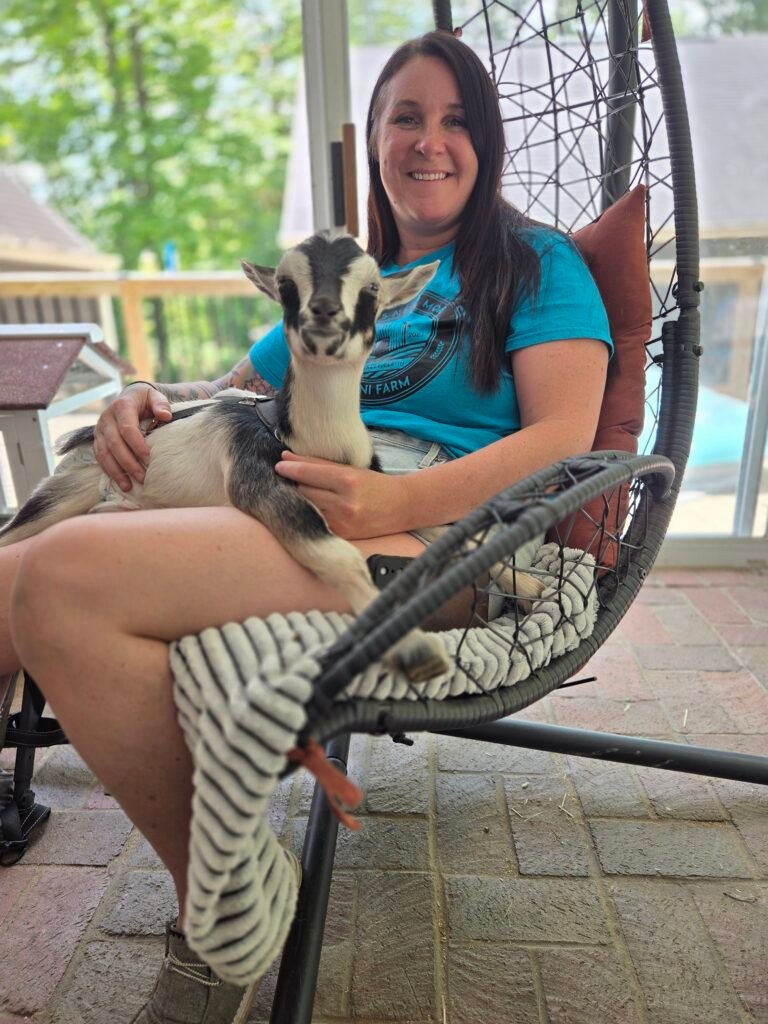
“I know she’s not going to have a long life. Her spine is curved and it’s gotten progressively worse. I know that. But we will make it the fullest life possible.”
That’s Cassie — founder of What’s a Few More Mini Farm in Mooresville, Indiana — talking about Pippy, a Nigerian Dwarf goat born paralyzed on the farm’s very first kidding season. Pippy came into the world with back legs that simply don’t work. Multiple breeders told Cassie to put her down. Cassie said no.
I met Cassie and Pippy at a local farmer’s market and when I asked if I could interview her, she said yes! I visited for an interview, and I’ve been coming back weekly since, doing acupressure and red light therapy sessions with Pippy. And Pippy’s made it very clear what she thinks about all of it.
More on that in a bit.
Meet Cassie — and the Farm That Keeps Growing
I visited Cassie on a warm afternoon and we did what you do at a mini farm: walked and talked at the same time, animals orbiting us the whole way. Chickens underfoot, ducks somewhere in the background, Grizzy — the Great Pyrenees livestock guardian — alternately making quiet rounds and sticking to us for lots of pets. There’s a comfortable chaos to it, and Cassie moves through it with the ease of someone who has found exactly where she belongs.
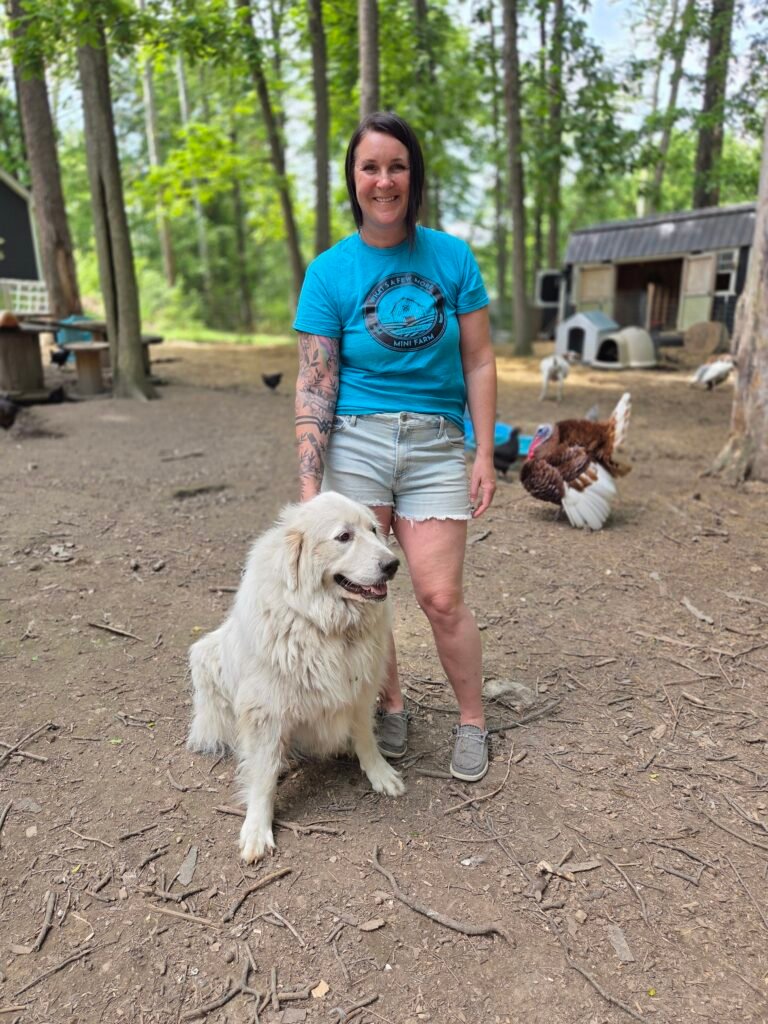
The farm started in 2023 with two pet wethers (male goats). Her husband asked what she could do with girl goats. One thing led to another. Now she milks daily, makes goat milk soaps, lotions, and face cream, sells at the Morgan County Farmers Market in Mooresville on Tuesday evenings, and runs an online shop at afewmoreminifarm.com. She recently left her day job — her husband’s call as much as hers.
“He said, ‘Honey, I think it’s just time for you to quit.’ I was like, What? He said, ‘We’ve been preparing for this. I think it’s just time.’ And I said okay.”
She laughed. “And then I was like, good thing I did!”
She grew up on her dad’s cattle farm in Eminence — showing cattle, pigs, cows — so animals were always part of her life. One summer, around seven or eight years old, she had a bottle-baby calf she named Annie. She led that little red heifer around the yard like it was the most natural thing in the world. She has a goat named Annie now. Some things come full circle.
“When I got goats, I didn’t realize how loving and sweet they could be. They’re heart-healing. They’re honestly more like dogs than I ever expected.”
A Kidding Season to Remember
This past spring was Cassie’s most intense kidding season yet — and it started with Pippy.
Then Opal had twins, but one was born still. Then Olive’s babies arrived on race Sunday, both coming out head-first at the same time, trying to race each other into the world.
“My vet had to drive up from Columbus, bless her heart, and she ended up elbow-deep in my goat. She had to push one baby back and then pull the other one out. It was a lot.”
It’s worth pausing here for anyone who thinks farm life is glamorous.
There’s also Yoda — a big, sweet singleton now — whose twin Anakin didn’t make it. The livestock guardian they had before Grizzy accidentally tackled Anakin and sent him into shock. Cassie treated him for four months, getting up every three to four hours through the night to give him medications. He was on the upswing when he got coccidia.
“None of my other goats had it, but it took him out. We ended up having to put him down after about four months of treatment.”
That experience is exactly why they were so deliberate about finding Grizzy, a trained Great Pyrenees who came to them through a friend. Cassie describes her simply: “She has just been the absolute best. She loves babies, and she is so good with the chickens.”
The First Kid Born on the Farm
Pippy was born paralyzed. Her back legs have no functional movement — never have. In her first month and a half, Cassie wasn’t even sure she could feel them.
“We were told by breeders that we should just put her down, that her quality of life wouldn’t be there. I said, I will make her quality of life fantastic. And I meant it.”
She did mean it. Pippy now wears a diaper, uses a custom wheelchair, and is, by all accounts, a happy goat. Getting Pippy up every morning — changing her diaper, getting her into her chair, getting her fed — is the first task of the day, before the chickens, before the milking, before anything else.
“It’s honestly like having an infant.”
But here’s what I find most significant as an animal communicator: Cassie didn’t just accept what the diagnosis said about Pippy’s experience. She paid attention to what Pippy herself was showing her.
With daily leg exercises — Cassie sitting Pippy in her lap each morning, bending and moving those stiff limbs — something started to shift.
“When we started doing more and more therapeutic work with her, she started responding. You could tell she could feel it. Then one evening, we were walking her and we saw her kind of flex her feet a little bit. My husband was like, ‘Do you see that?'”
She can feel her legs. She just can’t use them. Cassie knows this because she watched and listened — not to what the breeders told her to expect, but to what Pippy herself was demonstrating. That’s animal communication in its most fundamental form. Paying attention. Believing what the animal shows you.
Pippy’s spine has a progressive curve that’s gotten worse over time, managed with monthly chiropractic care. One leg is significantly stiffer than the other. Cassie knows this because every single morning, she’s the one in the chair with those legs in her lap, feeling where the resistance is.
“This one leg is always so tight — it barely bends at all. The other one does a little. She’s just so stiff.”
What It Means to Lose an Animal
I asked Cassie what the hardest thing has been to learn in all of this.
“This is a little morbid, but — death. Death is part of farming.”
She talked about her first rooster, the sweetest bird she ever had. He came down with coccidiosis and she didn’t catch it in time — roosters hide their pain until it’s almost too late. By the time she realized something was wrong, it was too late.
“He died in my arms and I sat outside sobbing. I called off work that day.”
There was also a chicken she accidentally harmed by letting fermented feed go too long in the summer heat. She tried to save her. She couldn’t.
“Those are the things that keep you up at night — when you know it was something you did, even if it wasn’t on purpose.”
She’s gotten better at carrying it. Not because it hurts less, but because so many other animals are depending on her.
“When I used to lose an animal, I’d be down for a whole day, just beating myself up. I still beat myself up, but I can’t hyper-focus on it the way I used to because I have so many other animals depending on me.”
That kind of hard-won perspective is something I see in people who take animal care seriously. The grief doesn’t go away. You just learn to hold it alongside everything else.
Frances Joanne
If you want to know who Cassie really is, ask her about her chickens.
Her favorite — though she’s careful about using that word — is Frances. Frances is her OG hen, named after Cassie’s mother, who died years ago.
“Frances has the same hairdo my mom had, so I had to name her that. She’s so sassy.”
She paused, then laughed.
“It’s funny — I get to yell at her now when she does something dumb. ‘Frances Joanne, cut that out!’ It makes me feel close to my mom.”
The Weekly Sessions with Pippy
After that first visit, I started coming back weekly to work with Pippy — combining acupressure and red light therapy as complementary support alongside her chiropractic care.
One thing I’ve learned is that hands-on work and animal communication inform each other. When I’m working acupressure points or moving the red light across an area, I’m not just following a chart mechanically — I’m paying attention to how the animal’s body responds, where they brace, where they release, how their breathing changes. Animals communicate constantly. The session is a conversation.
Pippy, for her part, is one of the clearest communicators I’ve worked with. She is not subtle.
When I apply the red light to areas she’s not interested in, or touch her front legs and shoulders, I get a headbutt. She’s pretty clear about that Nope. Not that. When I move to areas that feel good, she goes still, closes her eyes, and lifts her head slightly — the goat version of a deep exhale. Cassie pointed out that she starts chewing her cud during the red light portions that feel right to her, which is a sign of genuine relaxation in goats. Eyes closed, head up, cud chewing — Pippy is content, and she’s not hiding it.
That kind of directness is actually a gift in this work. Some animals take many sessions to trust the process enough to give you honest feedback. Pippy just tells you. I adjust every time she says no, and follow every time she says yes. That is the session — and it’s animal communication as much as anything else I do.
I use reference charts for arthritis, joint disease, and bone disorders — because even if Pippy’s condition is congenital, those meridian pathways address pain, nerve function, circulation, and tissue health in ways that apply across conditions. Hopefully PEMF therapy is also on the horizon; a tornado took out a section of their fencing earlier this year and put plans on hold, but Cassie is clear: they will get there.
What Pippy Is Teaching All of Us
I asked Cassie what the best part of farm life is. She didn’t hesitate.
“Just going out there and sitting with them. Especially if I’m having a bad mental health day — I’ll just go out there and sit. Sometimes I cry. They’re my medicine.”
She’s open about managing depression, and the farm has given her something to hold onto — something that needs her, that pulls her out of her own head and back into her body. Pippy has become an ambassador of sorts, invited to community events, beloved by Cassie’s daughters, a draw for people who’ve never given a second thought to a paralyzed goat in a wheelchair.
Pippy tries to jump into Cassie’s lap every single evening. She eats her hay enthusiastically from the basket in her wheelchair.
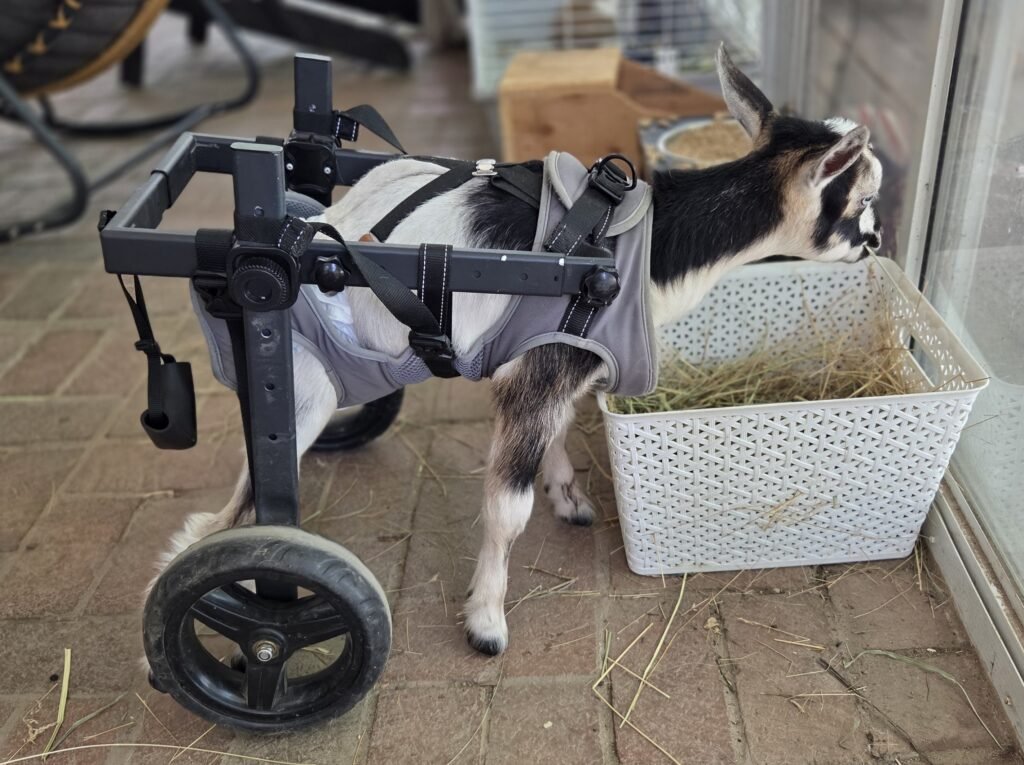
She naps in the pack-and-play in Cassie’s office. She comes to events in her diaper and draws a crowd. She is, by any measure, fully engaged in her own life — headbutting what she doesn’t want, chewing her cud when she’s content, eyes closed and head lifted when something feels just right.
That’s what animals show us when we stop deciding for them what they can and can’t experience.
“She’s teaching people — and teaching my kids — that life is worth showing up for, even when things are hard. She shows up every day, wheelchair and all. I think we can all learn something from that little goat.”
I couldn’t have said it better.
A Note on Acupressure and Red Light Therapy for Animals
Acupressure and red light therapy can be meaningful complements to conventional veterinary care and chiropractic work for animals dealing with neurological conditions, spinal issues, joint stiffness, and reduced mobility. They don’t replace veterinary care — they work alongside it. And when you combine them with attentiveness to what the animal is actually communicating, they become something more than a protocol.
If you’re curious about what your animal might be communicating — or how acupressure and red light therapy could complement their care — I’d love to connect. [Book a session / Contact me]