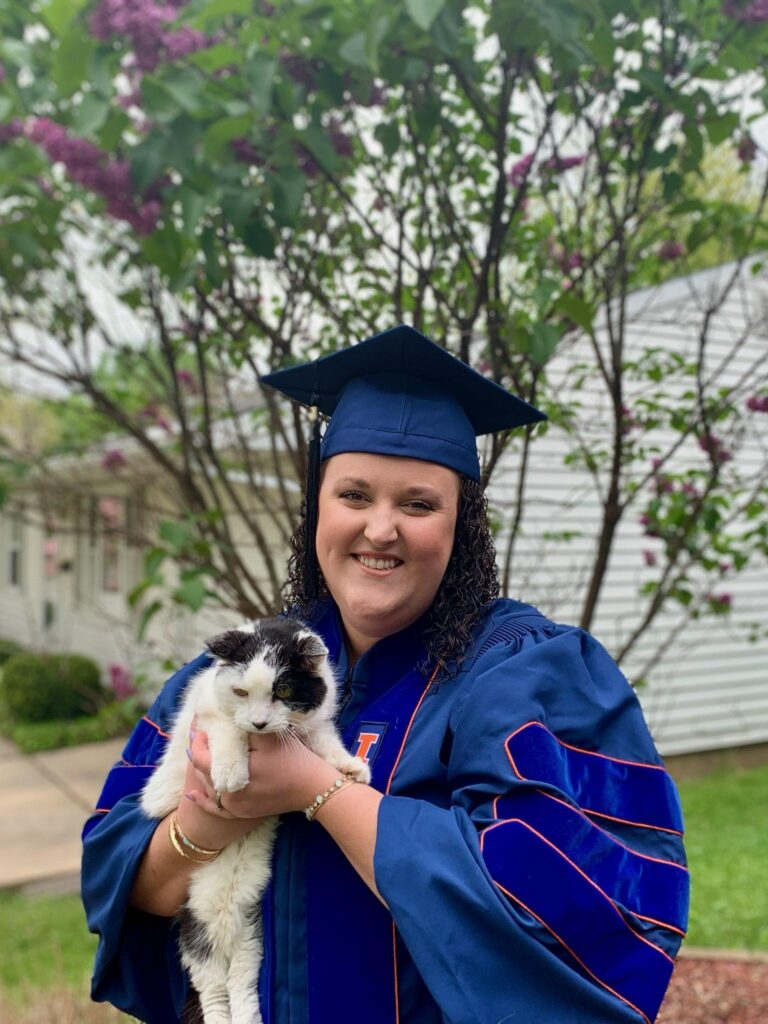
When Dr. Laura Gibson graduated from veterinary school, her sister had a cake made that looked exactly like Jasmine, the black-and-white cat Laura got for her ninth birthday, right down to the black spot in the right place and her little chin spot. Jasmine was still alive then, so Laura posed next to the cake holding her.
Laura and I worked side by side in practice for a while, learning together which patients did best with a butterfly catheter and lidocaine on a back leg, and which ones needed “less is more.” We are both Fear Free Certified, so those little things matter. She’s now seven years into her career as a veterinarian in Bloomington, Indiana. When we sat down in April 2025, she was honest about what this profession asks of the people in it, and why she still shows up.
How long had you been a vet when we talked, and why did you choose this path?
I will have been a vet for six years next month. That went fast. Most people say they’ve always loved animals, and that’s true for me too. But I was maybe 10 to 12 when I fixated on it. I was home from school watching Animal Precinct on Animal Planet, all those abused and neglected animals, and I wanted to be a vet in shelter situations. I started shadowing vets in my hometown in high school and saw my first surgery my junior or senior year. I was hooked. Every summer I worked at a vet clinic or the animal shelter. I never had a typical teenage job. I had tunnel vision.
Was there one pet who set you on the path?
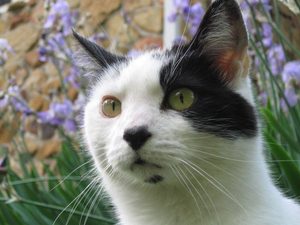
Jasmine, my kitty. She was my ninth birthday present. I haven’t had another cat since she passed, and it’s really been tugging at me lately. Maybe it’s time.
How many animals do you have now?
Depends on what you consider a pet. Two dogs, Gabby the horse, who’s 23, four goats, and 12 chickens. That’s 19. Knock on wood, we haven’t lost any of our farm creatures.
You said goodbye to Diesel, your older dog, in August 2024. What was that like?
I did it at home, and I struggled for a while with whether it was the right call. Rarely do they make it clear for us. He wasn’t really here mentally anymore. He paced the same trail and got stuck between the toilet and the wall. We’d tried everything for his pain. We walked him to the little park at the end of our street and let him wander in the sunshine while his sedation kicked in. Then I gave him ice cream in the kitchen. His last conscious thought was licking up ice cream. He fell asleep with his face in the bowl.
“How I do a euthanasia is probably one of the highest ways that I judge myself on how good of a vet I am.”
A pet’s last visit is one of the most memorable parts of owning them, so I take it very seriously, even at the clinic. It’s never easy for us, either. We do this every day, and it’s never easy. Even with Jasmine, I have regrets. She died in my arms. I went back and forth those last two days, and I waited too long.
How has veterinary medicine changed since you began your career?
COVID changed the whole world of veterinary medicine. Everyone got a pet while they were home, then everyone went back to work. We’ve seen a huge rise in anxious animals and in sheer numbers, while a lot of vets have left medicine. It’s become more chaotic and jam-packed. Corporations are also taking over, and it can start to feel like you’re a salesperson, which I try really hard not to be. It almost feels rare now to have a dog or cat who’s cooperative.
Suicide among veterinarians is high. You have coping mechanisms, but not everyone does. What helps you?
Social media is part of what makes it hard. You feel like you’re walking on eggshells, because one mistake can end up on Yelp or Google, and one person can make it go viral. I’ve watched that happen in real time in vet Facebook groups. Everyone grabs their pitchforks and goes after one person. That’s what drives a lot of good people to think about suicide, or to leave altogether.
For me, it’s boundaries. When I started, I’d work until seven, leave at eight, and be back at 7:45 the next morning. I was drowning in charts. Going from four days a week to three made the difference. I would have missed putting my daughter to sleep.
“At the end of the day, I’m replaceable to the world of vet med. I’m not replaceable to her.”
It also helped that our team wrote protocols for routine results, so the simple things don’t all land on my desk. My technicians start my records, and we’re trying an AI record-keeping tool. I’m type A and a perfectionist, so that helps. The more I do this, the more confident I get in what I can handle and when to say no.
Is there a patient who sticks out to you?
Two. Ruby is a little chocolate lab with squat legs, almost a corgi-lab. She came in a little off, and on X-rays her spleen looked funky. The ultrasound showed nodules. I told her owners upfront I’d never done a splenectomy and was happy to refer them. They put their eggs in my basket. I prepped for weeks and sweated through the whole thing, but it went remarkably well, and the spleen came back benign. She’s 14 or 15 now, still sweet, and her owners are so appreciative.
The other is my mom’s cat, Neville Longbottom, a big gray tabby. Mom picked him partly because of the cute black speckling in his right eye. I didn’t think that eye looked normal. He also had a right-side head tilt and an odd saunter. My dad insisted that’s just how Neville chooses to walk. Over about a year, Mom’s photos showed the pigment growing. We finally saw an ophthalmologist, who recommended removing the eye. It took a couple of months to convince Mom, and she watched over my shoulder while I did the surgery. The biopsy came back ocular melanoma, and chest X-rays beforehand had looked clear. It was the best-case scenario, and it’s a shared eye-nerd thing between me and my mom now.
If you could specialize, what would it be?
If I embraced my nerdy side, ophthalmology. Or going back to my roots in shelter medicine. I’ll never say never. There’s a brand-new shelter a couple of miles from me that I haven’t been inside, because part of me knows I’d want a job, or come home with a cat. Or both.
Dog or cat: which do you prefer to treat?
In this moment, a cat, though it depends on the cat and the dog. Cats are generally easier to examine. I feel like I miss less. I can palpate their abdomen more easily, and I’m not on the ground wrestling.
How has Fear Free changed the way you work?
I’m not afraid to say, “This is too much. We need to stop and come back another day.” Most clients are thankful. As an assistant, I once did a nail trim on a mastiff with five of us lying on him, a dog strong enough to seriously hurt himself or one of us. Baby-vet Laura would have just pushed through. Now I sedate far more, and I’d say more than half my patients come in on pre-visit medication like gabapentin or trazodone. If the pre-visit meds weren’t given, I don’t feel bad rescheduling.
Last week, a dog who hadn’t been in for a couple of years came in, and the owner didn’t give the medication I sent home. Her preteen son had his face right up in the dog’s face. I asked him to move. The minute I poked that dog, he turned to bite. That would have been the boy’s face. I’m not making these instructions up to be a hard-ass. There are reasons. I also note how every animal did at every visit, so I can see what worked and whether things are improving or escalating. When people push back, I tell them it doesn’t make me feel like a good human being to pin down their dog. Most say, “Yeah, that’s fair.”
What’s one thing you want owners to know?
Two things. First, preventive care is much cheaper than treating the disease we’re preventing. Give your heartworm and flea and tick medication. Second, we’re on the same team. When I recommend bloodwork or vaccines, I’m not padding the bill. I’m looking for something specific, because it’s good medicine. And if I send you home without what you expected because your animal is struggling, it’s because I want the visit to go well and your pet to feel safe.
“I’m not in it for the business of veterinary medicine. I’m in it for the welfare of your pet.”
Two things stay with me from this conversation. The first is Diesel’s last moments: a walk in the sunshine, then ice cream in his own kitchen. A goodbye can be gentle, and it can be planned. The hardest part is usually getting to the decision.
Laura and I both know what it is to wait too long. I did it with a cat years ago, before I had any veterinary background. I struggled with the decision for my girl Shelby too, even with the work I do. I don’t read my own animals, because I can’t be objective.
I’ve had the privilege of reading two of Laura’s animals. I connected with Diesel about a year before he passed, and also with Jasmine. Afterward, Laura wrote:
“Connie took some time to connect with my long lost heart pet [Jasmine] recently. Her message was a treasured gift and provided me with immense peace, although bittersweet. Connie is very passionate about what she does and is always friendly, caring, and professional.” — Dr. Laura Gibson, DVM, Bloomington, IN
Read more from clients on my testimonials page.
If you’re facing that decision, or still carrying one you made long ago, you don’t have to do it alone. An animal communication session can sit alongside your vet’s guidance as one more way to listen.
The second is how heavy this profession can be. A CDC study published in JAVMA found female veterinarians were 3.5 times as likely, and male veterinarians 2.1 times as likely, to die by suicide as the general population. Be kind to your vet team. And if you’re struggling yourself, you can call or text 988 to reach the 988 Suicide & Crisis Lifeline (US).
This post is for educational purposes only and is not a substitute for veterinary care. Always consult your veterinarian for your pet’s health needs.