A visit to Bee Lyvely Farms with Indiana beekeeper John Lytell
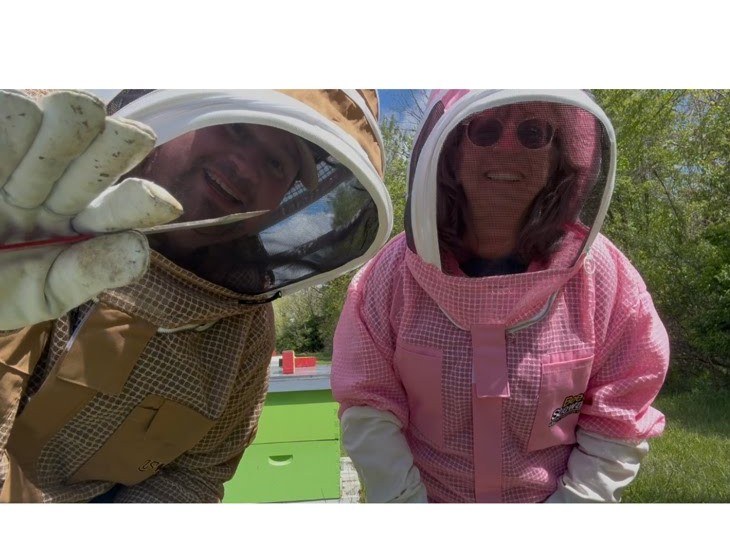
He met me at the car with a bright pink full-body beekeeper suit. I put it on and could only think that I looked like the Stay Puft Marshmallow midget! The crotch was down to my knees since this suit was made for someone much taller so I looked like I had really short legs and a VERY long torso.
Meanwhile John Lytell — beekeeper, calm human being, and proprietor of Bee Lyvely Farms — was already in just a jacket and a veil. Of course he was.
We drove out to the hives and before we’d even parked, he pointed out a swarm on a nearby bush. Swarm? Isn’t that bad? No it’s not. A bee swarm is a large group of bees that leaves an existing hive together to start a new colony. In honey bees, it’s a natural reproduction process. They are looking for a new home. It is not dangerous.
John runs Bee Lyvely Farms, an Indiana family-owned apiary and proud member of Indiana Grown. He and his family have spent years caring for bees and crafting honey, herbal teas, and natural homemade products they now share with others. He is also one of the nicest people I’ve ever met — and after spending a morning with him and his 50 hives, I understand why. The bees have something to do with it.
First Lesson: Move Like Kung Fu Panda
Before I got anywhere near a hive, John gave me my marching orders. Slow. Deliberate. Fluid. (He helpfully clarified for the animated-movie-challenged among us: that’s Tai Chi.) And if I ever started smelling something like banana Laffy Taffy? That was the alarm pheromone. Time to move far away.
He used a smoker packed with pine needles to calm the swarm we’d spotted on arrival, got them transferred into a box, and off we went to meet the rest of the family.
John has about 50 hives in total. I met Russian, Indiana, and Italian bees — each with their own distinct energy. He’d lift the tops, pull out honeycomb panels (some literally dripping), and I watched new bees — identifiable by the fuzz still on their heads — crawl across my suit. They were licking me. They were curious.
According to John, they liked me. I believe him.
I’ve never thought of bees as cute before. I do now.
A Conversation with John
I sat down with John to go a little deeper — about his path to beekeeping, what he’s learned from the bees, and what he wants people to understand about these remarkable insects.
How long have you been a beekeeper, and where did the interest begin?
John has been keeping bees for seven years, but the roots go much further back than that.
“Since childhood, I’ve always been into nature. My mother is a horticulturalist and raised us in the natural ways first.”
That upbringing shaped everything. When I asked how far back his love of animals goes, he didn’t hesitate.
“Since childhood, I was taught to appreciate and respect all living things — and to appreciate them and their function in the ecosystem.”
That phrase — their function in the ecosystem — stuck with me. It’s how John sees everything: interconnected, purposeful, worthy of respect.
How hard is it to manage 50 hives?
I expected a complicated answer. What I got was the most grounded thing anyone has said to me in a long time.
“It’s easy when you know you aren’t in control — and that’s okay.”
This landed differently for me as an animal communicator. So much of what I do is about releasing the need to control outcomes — about listening instead of directing. John and the bees figured this out a long time ago.
What are the best parts of beekeeping?
“You have to be calm no matter what’s happening in your life, or it won’t be enjoyable for anyone. So calm is what I am — and it’s very grounding.”
I watched this in action during our visit. We checked two “hot” hives — ones that had been aggressive and concerning. The one John had been most worried about had noticeably settled. The queen appeared to be maturing, and as she found her footing, so did her whole hive. The other hot hive was more intense — I didn’t sense aggression directed at me personally, but I could feel the edge there. They did not appreciate having their panels removed mid-workday.
Fair enough.
Every single hive I touched had its own energy — its own personality, its own frequency. The busy ones felt industrious and focused. The calm ones felt almost meditative. And the happy hives? John put it simply: honey bees are happy when they’re making honey. It sounds simple. It’s actually profound.
What are the hardest parts?
John didn’t hesitate on this one either.
“The ignorance of the general population. And like most ignorance, it leads to fear — which makes people do dumb things that cause problems. It all works out in the end, of course. But in any situation, it’s good times with love if you are unsure about anything.”
Good times with love when you’re unsure about anything. I’m going to be thinking about that for a while.
What are the best practices for keeping bees?
“Keep a schedule to be used as a guide — and be intentional when you work with the bees. Know that they mirror energy, and that can be good or not so good. So just be good.”
There it is. The whole thing in one sentence. They mirror your energy. Show up distracted, anxious, or checked out — and you’ll feel it. Show up present and intentional — and so will they. I’ve said something very similar about animals in communication sessions more times than I can count. John just said it better.
Bee buzzing — typically 200–250 Hz — has been shown to have a calming effect on humans, lowering cortisol and promoting relaxation. Do you agree?
This one was personal to me — and it tracks with what I experienced that day. The hum of 50 hives on a quiet spring morning is unlike anything I’ve heard before.
“Yes — the buzz helps create the calm you have to have when working with the bees. You must be calm, or they will swarm you to push you away so they can be calm. Or you get calm, and they just keep doing what they do.”
Sound healing practitioners have worked with frequencies in this range for years. The bees were ahead of us.
What can people do to help make sure bees don’t disappear?
“Learn what you can about bees and how they affect what interests you. And always lean with love.”
Always lean with love. From a man who manages 50 hives by simply accepting he’s not in control — it makes complete sense.
What I Took Home
I left Bee Lyvely Farms with pine-needle smoke still faintly on my shirt, a new appreciation for insects I’ve admired from a relatively safe distance my whole life, and a few things I keep turning over:
That calm isn’t passive. It’s a choice you make — for yourself and for the animals around you. That presence matters more than control. And that every living thing, down to a honeybee crawling across your sleeve to lick your glove, has its own energy, its own personality, its own way of being in the world.
John has invited me back for the honey harvest. I will absolutely be there.
And he told me that if I ever wanted to keep bees, I should — because they liked me.
Maybe one day. 🐝
You can find Bee Lyvely Farms and their honey, herbal teas, and natural homemade products through Indiana Grown and their farm page. Support local beekeepers — they’re keeping more than bees alive.
Special offer for you if you’re reading this: If you order from Bee Lyvely Farms online, note “Dynamic Animal Communication” in the order comments — and they’ll send you a free 2oz bee pollen as a thank-you. 🐝See their products here: https://bee-lyvely.square.site/