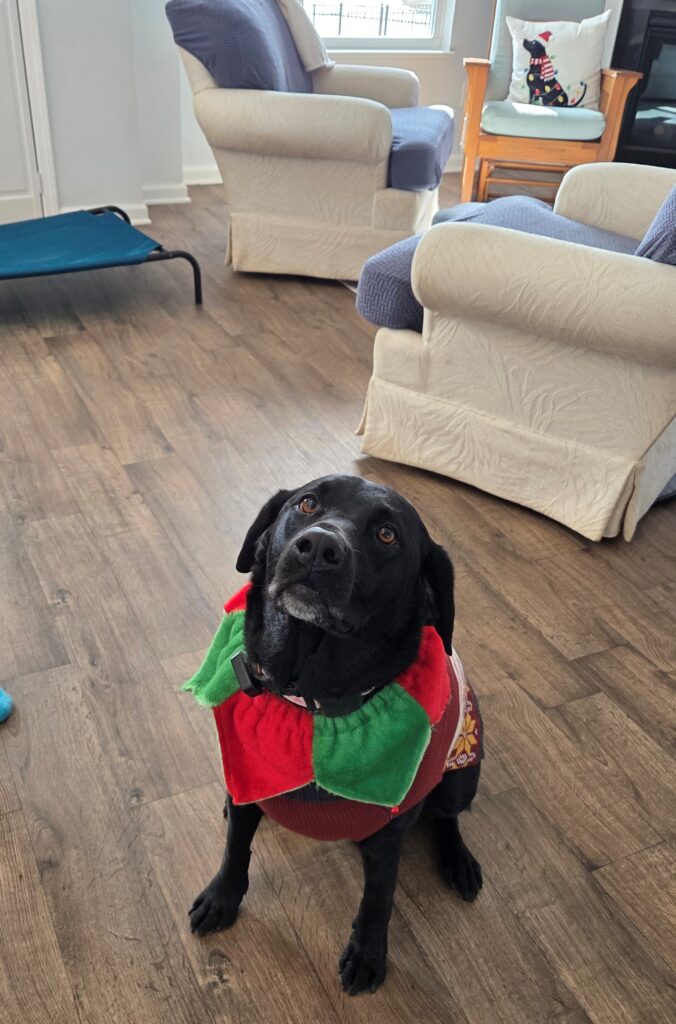
Meet Maddie—a five-year-old black Labrador with a heart as big as her appetite and energy that could power a small city. She’s the kind of dog who greets everyone like they’re her favorite person in the world, who lives for walks, playtime, and any activity that involves food (which, let’s be honest, is most activities for a Lab).
But last fall, everything changed.
Maddie started limping. At first, it seemed minor—just a little hitch in her step. But as weeks went by, the limp persisted. Her owner knew something was wrong, but figuring out exactly what was proving difficult. X-rays of her elbow showed no damage, leaving everyone puzzled about what was causing her pain.
That’s when I met Maddie.
Listening to What Maddie Had to Say
In November, I began working with Maddie through an animal communication session. My goal was simple: ask Maddie what happened and understand what she was experiencing.
What she told me was straightforward—she had stepped in a hole in the backyard. Not a dramatic injury story, just an unfortunate misstep. My scans of her kept gravitating to her shoulder, rather than her elbow. This made far more sense than the elbow theory and aligned with what a holistic veterinarian would later confirm: Maddie was dealing with shoulder pain, not an elbow issue.
But here’s the thing about Maddie—and many dogs like her—she doesn’t really believe she’s injured. To her, this whole “rest and recovery” business is just an annoying interruption to her regularly scheduled programming of running, jumping, playing, and being her goofy, enthusiastic self. Anything that interferes with play? Completely unacceptable in Maddie’s world.
And that’s where the real challenge began.
The Catch-22 of Recovery
Maddie’s recovery requires rest. No running, no jumping, no wild outdoor play sessions. For a dog who thrives on movement and activity, this is torture. Add to that the fact that Maddie needs to lose weight to take pressure off her injured shoulder, but she can’t get her usual exercise—well, you can see the problem.
When we started working together, Maddie weighed 72 pounds, but has since gained two more despite our best efforts, bringing her to 74 pounds. A better weight for her is around 65 pounds. Her owner thought she was being careful with Maddie’s diet, but found out that even the chewies she was giving her were adding to her caloric intake. Weight loss will help speed her recovery since every extra pound puts more stress on an already compromised shoulder.
We adjusted her diet, added Dasuquin joint supplement and fish oil for omega-3s to support her joints. But managing her weight is only part of the equation. The bigger challenge? Keeping Maddie’s mind engaged when her body needs to stay calm.
Enter: Acupressure and Enrichment
I’ve been seeing Maddie weekly since November for acupressure sessions. Her owner is also working with a holistic veterinarian who uses tuning fork therapy, and at home, they’re using a PEMF machine and red light therapy to support her healing. It’s a comprehensive approach, and Maddie is getting excellent care from multiple angles.
During our acupressure sessions, I start and end with bladder sweeps along the bladder meridian. This helps me assess any areas that feel tight, hot, or cold, and it has a calming effect on Maddie. I use specific acupressure points for pain relief, overall health, mobility support, and relaxation. I also incorporate gentle shoulder massage before we close with another bladder sweep.
Some days, Maddie settles beautifully. She’ll stay in her chair even after I leave and sleep the entire afternoon away—clear evidence that her body needed the rest and responded well to the session. Other days? She has a harder time settling down. The longer we go into this period of enforced rest and limited play, the more restless she becomes. It’s frustrating for her, and I can feel that energy during our sessions.
That’s when I realized: acupressure alone wasn’t going to be enough. Maddie’s mind needed just as much attention as her body.
Things That Make Maddie Go “Yeah!”
We recently started incorporating indoor enrichment into Maddie’s routine for mental stimulation to help wear her out.
Last week, we worked on teaching her to “shake.” Now, you might think food would be the obvious reward for a food-motivated Lab, but we discovered something interesting: Maddie’s favorite ball works even better as a motivator. When I showed her the ball, she smacked her paw into my hand like, “Okay, I’m shaking! Now give me the ball!” It only took her three or four tries to get it, and when she succeeded, her whole body lit up. Her tail—no, her entire butt—wagged with pure joy.
This was an important lesson: rewards don’t always have to be food. In fact, for a dog on a weight-loss regimen, finding non-food rewards is essential. For Maddie, that ball represents play, excitement, and accomplishment. It engages her mind and gives her a sense of purpose without adding calories or compromising her recovery.
This week, we’re introducing food puzzles and a snuffle mat. We’ve tested out “find it” games and other basic obedience commands. We tried some enrichment activities before her last acupressure session, hoping it would tire her out mentally and help her settle. Unfortunately, it had the opposite effect and it took her much longer to settle into her session. Lesson learned! Her owner did report that she rested very well the rest of the afternoon.
The Setbacks and the Reality of Recovery
Recovery isn’t linear. There have been improvements—last week, Maddie was walking much better, moving more comfortably, and showing signs of real progress. But there have also been setbacks.
When Maddie’s owner feels bad about her being stuck indoors with limited activity, it’s tempting to let her have a little outdoor playtime. Just a bit of running, a few tosses of the ball—what harm could it do? But that’s when the limping returns. The shoulder flares up again, and we’re back to square one.
It’s hard. Really hard. No one wants to see their dog bored, frustrated, or missing out on the things they love. But this is where discipline and consistency matter most. Rest isn’t negotiable during recovery, and finding creative ways to keep Maddie engaged indoors is the key to supporting her healing while maintaining her quality of life.
What I’ve Learned from Maddie
Working with Maddie has reinforced something I see time and again in my practice: our animals need mental and emotional enrichment just as much as they need physical exercise—sometimes even more so.
When a dog is recovering from an injury, managing a chronic condition, or simply dealing with reduced activity during winter, enrichment becomes essential. It’s not about replacing physical activity; it’s about giving them purpose, challenge, and joy in ways that don’t compromise their healing.
For Maddie, that means:
- Learning new tricks that engage her sharp mind
- Using non-food rewards that excite her without adding calories
- Incorporating food puzzles (with a portion of her regular meal) and scent games that satisfy her natural instincts
- Acupressure sessions to help her body relax, ease pain, and balance her energy
Every dog is different. Some will respond to food puzzles, others to scent work, and some—like Maddie—will light up for a favorite toy. The key is paying attention to what makes your individual dog say “Yeah!” and building enrichment around that.
Want more ideas for keeping your dog mentally engaged? Download my free enrichment guide for activities you can do at home, even when physical exercise is limited.
How Animal Communication and Acupressure Fit In
Animal communication helped us understand how Maddie injured herself when traditional diagnostics couldn’t provide a clear answer. It gave us a starting point and allowed us to approach her treatment with accurate information. But beyond the physical injury, communication also revealed Maddie’s emotional state—her joy! Joy for life, boundless love for all humans and food, but also her stoic attitude about pain, which is very common in animals, even domestic ones.
Understanding these feelings helps us work with Maddie more effectively. We know she needs mental engagement to offset her physical limitations. We know she’s going to test boundaries because she genuinely doesn’t understand why play is off-limits. And we know that celebrating small victories—like mastering “shake” or settling during a session—matters to her.
Acupressure supports her physical healing by reducing pain, improving circulation, and helping her body relax. But it also provides something equally important: connection. Those weekly sessions give Maddie calm, focused attention. They tell her she’s cared for, even when she doesn’t understand the bigger picture of recovery.
Moving Forward
Maddie is still healing. We’re still working on weight loss, building her enrichment routine, and navigating the ups and downs of recovery. Some weeks are better than others. But every session teaches us something new about what Maddie needs—and what works.
If there’s one thing Maddie’s story illustrates, it’s this: healing isn’t just about fixing what’s broken. It’s about supporting the whole animal—body, mind, and spirit—through the journey.
If your dog is struggling with recovery, injury, or winter blues, animal communication and acupressure can help. Book a session and let’s support your pup together.