A Conversation with Melissa Chandler
Melissa Chandler wears many hats: dog trainer, competitive dog sports enthusiast, holistic pet health coach, certified canine professional nutritionist, Reiki master, animal communicator, and EFT practitioner. Based in Sunbury, Ohio, near Columbus, Melissa’s journey into holistic animal care began not in a classroom, but through the lessons her own dogs taught her—often the hard way. From a Weimaraner paralyzed by a vaccine reaction who became a national agility champion, to discovering that many “behavior problems” are actually undiagnosed medical issues, Melissa brings decades of hands-on experience and a passionate commitment to looking deeper. Her work now focuses on helping animals and their people connect more meaningfully while addressing the root causes of their challenges.
How did you get started in all of this?
I started with dog sports first. I began training when I was about 12 years old in 4-H with a toy poodle. My parents used to tease because they drove me all over the country for dog sports competitions. Then my brother got into motocross, and we’d always joke about who was more expensive. You can throw away a motorcycle and get a new one, but with dogs, you have to keep up with their health care.
Agility was my main sport in the beginning, and I also do nose work. I taught for Fenzi Dog Sports Academy and ran my own private business locally. I’ve also taught conformation and, more recently, dog parkour.
What led you into holistic healing?
That journey started in the mid-90s with a Weimaraner named Catfish who was diagnosed with inflammatory bowel disease. He was six and a half years old, and the medication they had him on was killing him before my eyes. I thought, there has to be a better way.
I found a holistic vet who did acupuncture and herbs. We got him off all his meds, put him on a raw diet, and he lived to be 14 and a half years old. When I saw that difference, I knew we were never looking back.
We were buying prepared raw food for him, and when I saw the results, I wanted to put my other two Weimaraners on it too. But I had three Weimaraners, and the cost would have been more than my mortgage payment. So I dove in and learned to do it myself. This was before we had all the resources we have now. I got a book, studied the food I was buying, and we had a food-making day once a month. We bought a freezer and spent one day making their food and freezing it.
It sounds like each of your dogs taught you something important.
Absolutely. My next dog had the most severe reaction to metronidazole when he was treated for giardia—he started having seizures. It was awful. He taught me to check medications and their side effects before using them. This was the early 2000s.
What really upset me was that I trusted my vet. When he had a seizure and fell down the steps, I called her and she said, “Oh, it’s the metronidazole.” I was shocked. Maybe you should have told me this before we gave it to him? She sent me to the emergency hospital, and the vet there walked in, didn’t even look at my dog lying on the floor, and said, “I read the chart. Yeah, it’s the metronidazole.” No one had warned me about seizures as a side effect.
He never fully recovered. He lived to be 14 and a half years old and was really good at agility and an incredible conformation dog—his movement was impeccable. But he lost that because of the metronidazole. He always had a hitch in his step after that. I probably spent enough to buy a house trying to save him, and the makers of metronidazole wouldn’t do anything because it’s not approved for animals.
What about vaccine reactions?
My next dog had a vaccine reaction at a very young age and I almost lost him. That’s when I learned about over-vaccination, titers, and homeopathics. He was saved by homeopathics. He was paralyzed from the vaccine reaction.
He went on to become my agility superstar—the number one Weimaraner in the country in agility for about five years. We went from paralysis to national champion. Looking back now, I know that he and I were communicating at a much different level with the way we ran courses. We were like one. It was like a dance. I didn’t realize it at the time, but I was definitely doing animal communication because we had that connection. This was around 2004.
Unfortunately, I did lose him to fibrosarcoma, which is cancer caused by vaccines. Even though we got him back on the road to health and he did really well for years, the vaccine still took him in the end.
When did you formally start studying animal communication?
My current Weimaraner, Grit, gave me the final push. He was the pick of the litter—this brilliant little puppy who learned things so fast. Then suddenly it was like he stopped. He couldn’t learn anymore, couldn’t comprehend. He started getting bloody pustules all over him and his feet were bleeding.
All my local vets said he was okay, nothing was wrong. His feet would bleed in the snow and they’d say, “Oh, it’s because of the snow.” But this had been going on since August—we didn’t have snow in August.
I found a vet in Chicago who was an animal communicator. We did an online consult and she talked to Grit first. Because of what he was going through and everything I’d been through with my other dogs, that’s when I started looking into taking animal communication classes. I think all my dogs were preparing me for this journey, and Grit gave me the final push.
I started in October 2022 and graduated in June 2024. Grit has been my healing helper. He’s attended every class with me, every case study. When people would break down during our EFT sessions, he would get up and look into the computer like, “Are you okay?” He’s so in tune with me and everyone else. He knows how to position himself on the Zoom screen.
How did you become a pet health coach and nutritionist?
When I started doing case studies for animal communication, I would do medical intuition and everyone would ask, “How do I fix this? What do I do?” As a case study where they weren’t paying me, I could help them. But I realized that once I started getting paid clients, I wouldn’t be able to give that advice without proper certification.
So I became a holistic pet health coach in January 2024. I hadn’t really done it to take on clients—I did it so I could continue helping my animal communication clients after the medical intuition. But I enjoyed it so much that I started offering it as a separate service.
I’ve been doing all of this informally since the early 90s. I’ve been fortunate to work with holistic vets who took me under their wing. I’ve always been a lifetime learner—if I’m not learning something, I’m not happy. Anytime someone wanted to put their dog on a raw diet, they’d come to me for help, so I’d already been doing this work since around 2000.
Then I enjoyed the pet health coaching so much that I wanted to learn more about nutrition, so I pursued the canine nutritionist certification.
How challenging was the nutritionist certification?
It was challenging. You need to learn all the different organ meats and what they provide, what provides vitamin A, what provides calcium, how to put a diet together with proper nutrition. It wasn’t something you could fly through—you really had to study and apply yourself.
I do elemental diets for my dogs now based on Traditional Chinese Veterinary Medicine food therapy. I have two fire dogs and a wood dog, which is funny because my husband Gary is a fire and I’m a wood. So we have three fires and two woods in the house.
Gary was doing something silly while we were trimming nails, and I told him to stop. He said, “You’re just like Bam,” who’s our wood dog. “He doesn’t appreciate my shenanigans.” I said, “We’re the wood elements—we don’t appreciate your shenanigans when we’re trying to focus on a task.” He said, “Well, Mojo and Grit do.” I said, “Of course they do—they’re fire like you!”
Tell me about nose work. How did you get into that?
I started nose work in 2015 with my fourth Weimaraner, Edge. I’d been doing agility with all my others, but Edge was a very big Weimaraner and he made it clear he didn’t like agility. His breeders in California suggested I start teaching nose work. I said I didn’t know anything about it, and they said, “Well, go learn.”
We took an online class and learned nose work. Then Denise Fenzi at Fenzi Dog Sports Academy asked me to teach for her, which was funny timing since Edge’s breeder had just told me I should teach it. Edge was the one who got me into nose work, and he taught me more than my classes did. He was incredible at the sport—he knew far more about it than I did.
Nose work is a fabulous sport for all dogs. All dogs can do it. You can do it in your house, your front yard, at the park. You don’t have to have specific places or compete—you can just do what you want.
What about dog parkour?
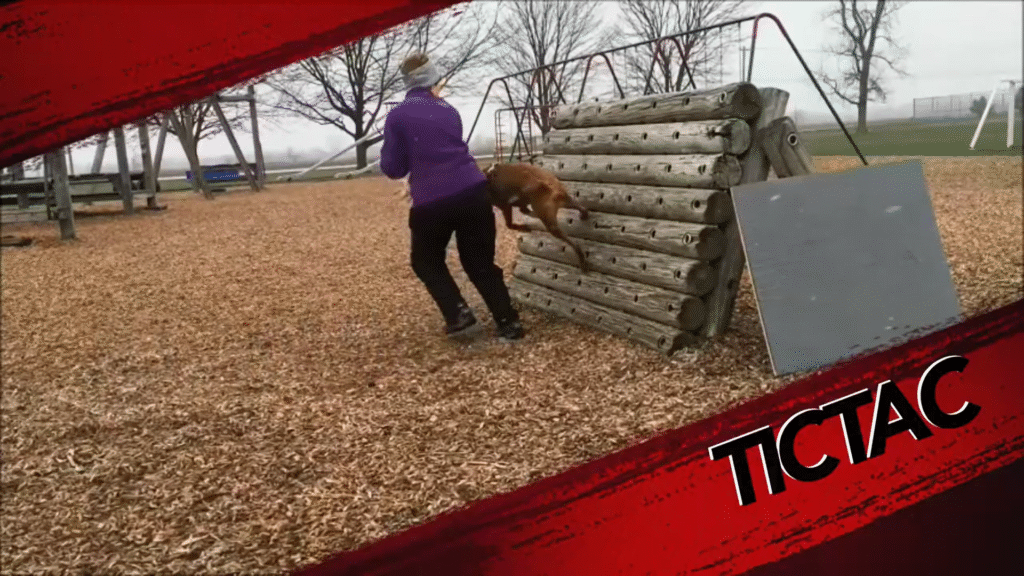
I teach dog parkour as well. My 11-year-old Vizsla loved it—jumping, leaping, handstands. He could jump six feet high, walk on narrow surfaces, walk and turn. He was the one who got me into real parkour and I started teaching classes for it.
Funny enough, I had a toy poodle when I was 12 or 13, and we did some 4-H events where we were actually doing parkour before parkour was really a thing.
When you’re dealing with dogs, what’s the biggest issue you see?
This is one of my things that I talk about a lot: many times it’s not really behavior—it’s medical. People think it’s behavior, vets think it’s behavior because they can’t figure it out. I saw this so many times in agility classes, and it really pulls on my heartstrings.
I can see a dog struggling and the trainer says, “Oh, they’re blowing you off.” Most people believe that, but they’re not blowing you off—they’ve got an injury or they don’t feel good.
Let me give you two examples. My older Vizsla lives up to his name—he doesn’t back down from anything, pushes until he gets through, nothing stops him. He ran into a fence one time because he couldn’t get through, then backed up and ran faster to try again. That’s his personality.
So when we’d be walking and he’d just stop dead in his tracks and wouldn’t move, I knew something was wrong. I took him to the vet and they said he had a behavior problem. I said no, I know my dog. I took him to an eye specialist and they said everything checked out. I said no, I could feel something with his eyes.
I took him to another place and they diagnosed iris atrophy. They asked if it happened going from light to dark or dark to light. I said yes—it always happened coming home late at night or going out early in the morning. Once I gave him a few minutes, he was okay.
Everyone was telling me it was behavior, but it was iris atrophy. This is where knowing your dog’s essence comes in handy. If I had a shy, reserved dog, maybe it could be behavioral. But I know my dog—he doesn’t stop for anything. He stopped because he couldn’t see.
Do you have another example?
Yes, with Mojo, my young Vizsla. He was less than a year old, an intact male, and he would just start peeing while standing there. Once was on my bed, once was at an agility seminar. I could tell by the look in his eye that something was wrong.
We had testing done—no UTI. They said it was behavior. I said no, it’s not. I could “feel” something structural, like something was twisted. I took him to his chiropractor and his sacrum was out of place. She said when that sacrum hits a certain nerve and they move a certain way, it expresses their bladder. She’d had other clients with the same issue.
It took several adjustments to get it to hold. She warned me that sometimes it doesn’t get fixed right away and can be a lifetime problem. Fortunately, we got it corrected.
I find many times these are not behavior problems. People don’t dig deep enough, don’t know how to dig deep, or don’t know who to go to for help. That’s where medical intuition comes in—comparing what you’re feeling to what their essence is. Even litterbox issues aren’t always behavioral.
When I figured out what was wrong with my Vizsla, I cried because I thought about how many dogs have issues like this and are being corrected for something they can’t help. That’s where my heart always goes.
What about actual behavior issues like leash reactivity?
I get contacted a lot about leash aggression or dogs not playing nice with other dogs. I do EFT tapping sessions for this, and I’ve had pretty good success.
I had one client with a dog who was an agility superstar and speed demon but would get snarky with other dogs. She didn’t trust him off leash. We did three sessions, she did her homework, and now he’s out running in agility trials! She’d been doing all the traditional training work, and the tapping helped him break through that wall.
Can you share an EFT success story that stands out?
One case still blows me away. I’d been working with a couple—husband, wife, and their little dog. They were in bed when their house was broken into. At first they thought it was their son coming home, but the way the dog acted, they knew it wasn’t. The dog went under the table and started barking aggressively. The husband went downstairs with a pellet gun. The wife froze—she was going to call 911 but just froze.
Nothing bad happened, the person ran away, but she was so upset with herself and so panicked that she couldn’t sleep. She went to therapy and it didn’t help.
She was telling me about this during an animal communication session, and I suggested we do some tapping. As we wrote the script, I asked if this reminded her of anything. She said, “Oh my gosh, when I was six years old, my parents were going out to dinner with friends and dropped me off at their friends’ house. There were all these little kids there and I was told I had to babysit them. I was six. All I remember is standing there and this big black door shut—the door was big anyway and I was little—and it shut on me and I couldn’t do anything. That’s where all of this is coming from.”
Just doing that one script, she felt relieved and she slept that night. We tapped on her dog and tapped on her, and she said she had the best night’s sleep since the break-in happened. I’d never experienced EFT working to that degree until that moment.
That’s why I’ve been offering it to people at no cost—so more people will know about it. I know it will help, even if it doesn’t completely solve every problem.
If you only had time to say one thing to a pet owner, what would it be?
Connection. Enjoy the time. Get out in nature. Connect with your dog or your animal. Be aware of changes. A lot of us get lost because we’re so busy and we don’t notice changes.
I’m really big on connection, nature, and one-on-one time. No cell phones. Just you and your animal.