What happens when you can’t lie to a 1,200-pound animal? When your incongruence—the gap between what you say and what you feel—causes them to simply walk away?
That’s the world of Equine Gestalt Coaching, where horses become partners in healing, not through words, but through presence, honesty, and the kind of truth that can only emerge when we stop performing and start feeling.
I recently sat down with Lorrin Maughan, an Equine Gestaltist, animal communicator, and energy healer who works with horses as co-coaches in her practice. What she shared reminded me why animals are such powerful teachers—they meet us exactly where we are, without judgment, and invite us to do the same.
Shamwari is a word from the Shona language in Zimbabwe, and it means ‘my friend,’ but it implies something deeper—mutual respect, equality, and relationship.
Can you tell me what you do, beyond working with horses?
I do, yes. I have a day job in learning experience design for corporate clients. Alongside that, I run my animal communication and energy healing business, and I also have a coaching business. In my coaching work, I partner with my horses—they’re actually my co-coaches.
That’s amazing. Can you explain what that looks like?
Absolutely. I’m an equine gestaltist. It’s a coaching methodology rooted in Gestalt therapy principles, which focus on seeing people and situations as whole systems. It’s very experiential. Instead of just talking about something that happened in the past, we do what we call ‘experiments’ that allow clients to process things out of their body, emotions, and nervous system—not just intellectually.
This work is also informed by what I call Shamwari coaching. Shamwari is a word from the Shona language in Zimbabwe, and it means ‘my friend,’ but it implies something deeper—mutual respect, equality, and relationship. There’s no hierarchy in this work. I’m not above the client, and the horses aren’t tools or props. We’re all partners in the process.
Because this is coaching, not therapy, I’m not treating mental health conditions. But I am working with real human experiences—loss, stress, stuck patterns. Sometimes those experiences get lodged in the body, and that’s where this work is powerful.
That’s one of the reasons I love EFT, which Joan Ranquet teaches. It’s another way to release what’s stuck, whether that’s with animals or people.
The horses are completely autonomous in the coaching process. I tell my clients that it’s up to the horse if—and how—they interact. Even if a horse chooses not to engage directly, there’s still benefit. Humans and horses are both mammals, and just being within a horse’s energy field supports nervous system regulation. It can reduce cortisol, lower blood pressure, and increase serotonin. That puts clients in a much better state to actually work through things.
And you can’t lie to a horse. They’re prey animals, extremely intuitive and attuned to incongruence. If someone says one thing but feels another, the horse will pick up on that and may disengage. That feedback is incredibly valuable, because humans are very good at lying to ourselves.
What does a typical coaching session look like?
No two sessions are ever the same. I always start with a safety orientation—physical and emotional safety is my responsibility as the coach. From there, the work unfolds relationally. We slow down, get present, and listen—to the client’s body, to the emotions in the room, and to the horses.
That relational aspect is central to Shamwari coaching. Nothing is forced. We work with what’s showing up in the moment, because that’s usually what needs attention most. People often come in thinking they want to address one issue, and something entirely different emerges.
Sometimes a horse will interact while the client is talking. Other times I’ll have the client move their body. We might use an empty chair exercise, where they speak to someone as if that person were present. We might do physical release—like hitting a padded cube with a tennis racket or throwing horse manure—to safely discharge anger. The horses love honesty. They celebrate congruence.
We also do family constellation-style work, where clients physically step into different roles in their family system to gain perspective. That kind of embodied experience—being met without judgment, by both human and horse—can be deeply healing.
How do the horses react when someone is expressing strong emotions, like anger?
They love it. As long as the energy isn’t directed at them—which it never is—they recognize honesty. There’s no hierarchy or punishment in their world, just truth. When someone is congruent, the horses respond to that clarity.
I remember the first time I tried it myself; I expected them to react, but they didn’t care. When a client later released real anger, the horses became exuberant. They ran around, energized. It was incredible to watch.
How many horses do you have?
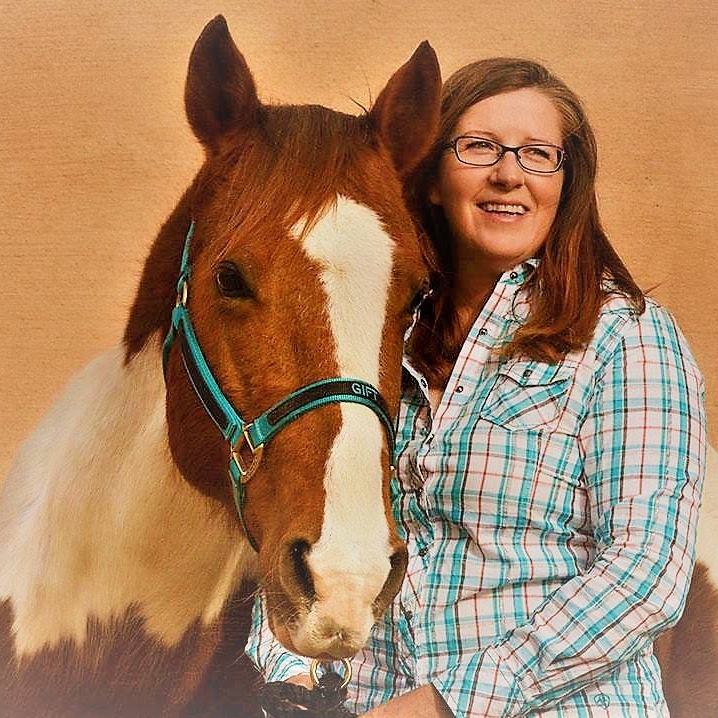
I have two: a mare named Gift and a gelding named Fella. Gift is about 25 now, and Fella is in his early twenties. That used to be considered old for horses, but they’re living longer these days—just like people.
How did they come into your life?
Gift came to me through a rescue. She was feral and deeply traumatized, and people believed she’d never be rehabilitated. I fostered her and her colt, Cody, hoping to help her learn to trust humans.
During an animal communication intensive, we asked the horses what kind of home they wanted. Cody was very clear—he wanted to be part of a family, not a sport horse. Gift was vague until someone finally asked her directly if she wanted to stay with me. Her response was, ‘Of course.’ That’s when everyone looked at me and said, ‘You have a horse.’
I resisted. I wasn’t planning to keep a horse. But life had other plans. A month later, the rescue owner told me she couldn’t stop thinking about how Gift and I belonged together. She waived the adoption fee, handed me the papers, and that was that.
Fella came into my life later through a series of events that felt just as orchestrated. He and Gift bonded deeply, and now they’re inseparable. They’re my perfect pair.
Do you have other animals as well?
I have four cats—possibly five soon. There’s a former feral who’s been slowly transitioning indoors. Fireworks worry me, so I’ll likely bring him inside permanently soon.
What first led you into animal communication?
It actually started with my cat Jasper. After I lost my soul cat, Toto, Jasper went into severe grief. He stopped eating, cried constantly, and tried to die. The vets couldn’t help.
A friend suggested an animal communicator. At that point, I was willing to try anything. During the session, the communicator connected with Toto and Jasper, and I could physically feel them. She knew things I had never told her. When she mentioned another deceased cat—Schroeder—and conveyed his very distinctive personality, that was it. I knew this was real.
Jasper recovered. And I needed to understand what had just happened. That’s what led me to Joan’s program.
If you could say just one thing to a horse guardian, what would it be?
Park your ego at the gate. Open your heart. Listen. Observe. Build the relationship before anything else.
* * *
What struck me most about this conversation was the profound respect woven through every part of Lorrin’s work—respect for the horses’ autonomy, for the client’s process, for what wants to emerge rather than what we think ‘should’ happen.
In a world that often values control and certainty, Lorrin’s approach offers something different: partnership, presence, and the willingness to meet ourselves and each other—human and horse alike—exactly as we are.
That’s where true healing begins.
Connect with Lorrin
Instagram: @shamwari (animal communication) and @shamwaricoaching (coaching)
Background: Lorrin grew up in Zimbabwe, where she learned the Shona language and developed her deep connection with animals. She now brings her gifts of animal communication, energy healing, and Equine Gestalt coaching to clients seeking transformation through relationship with horses.